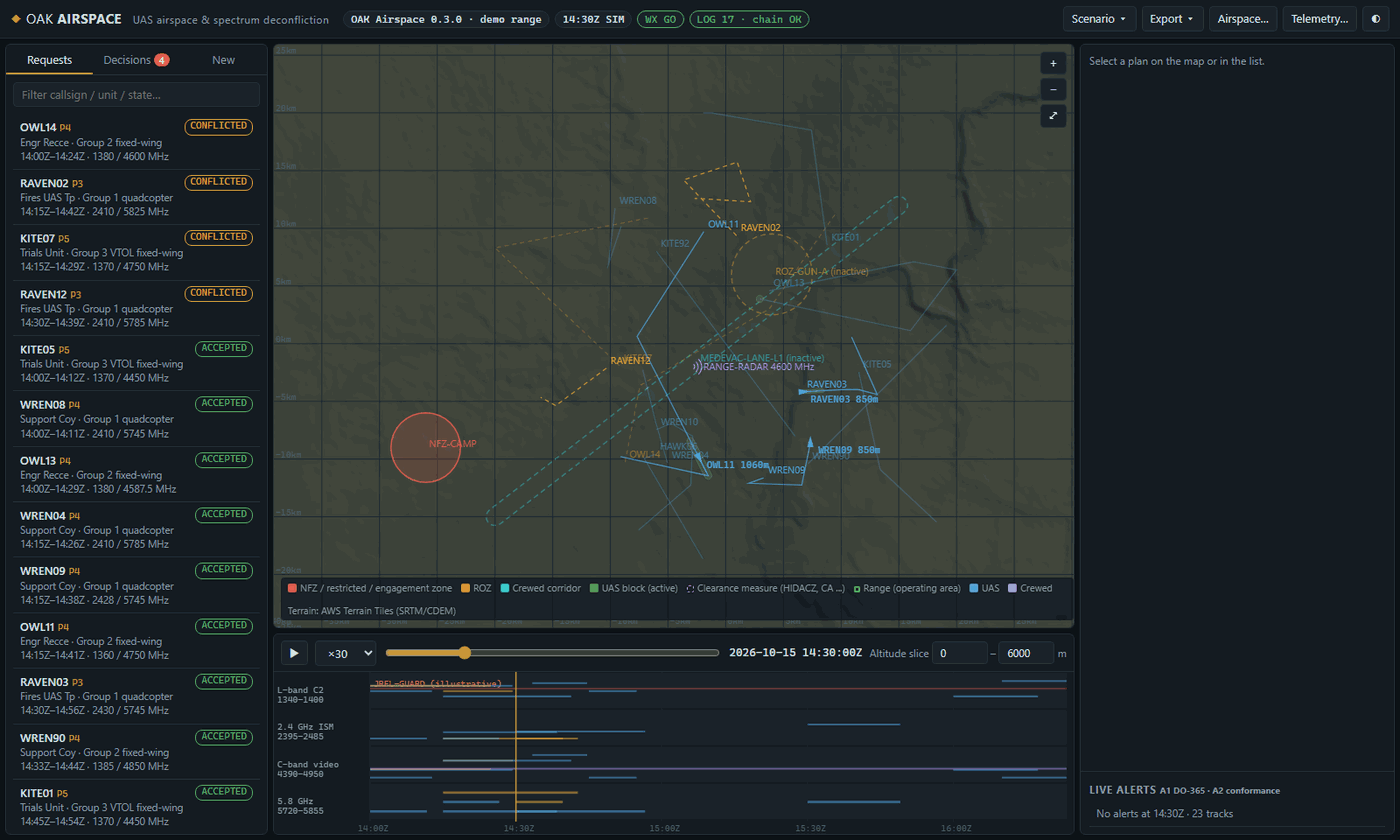
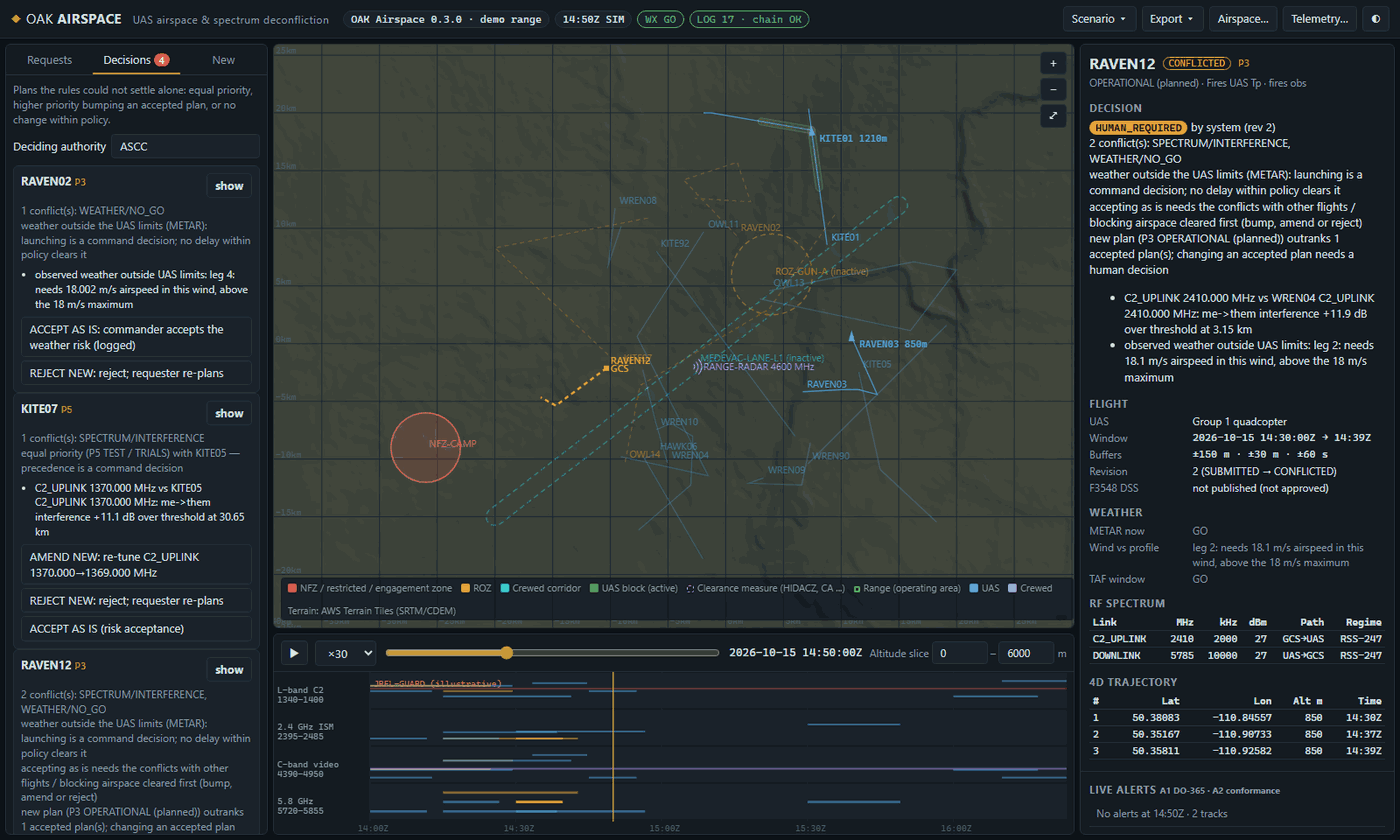
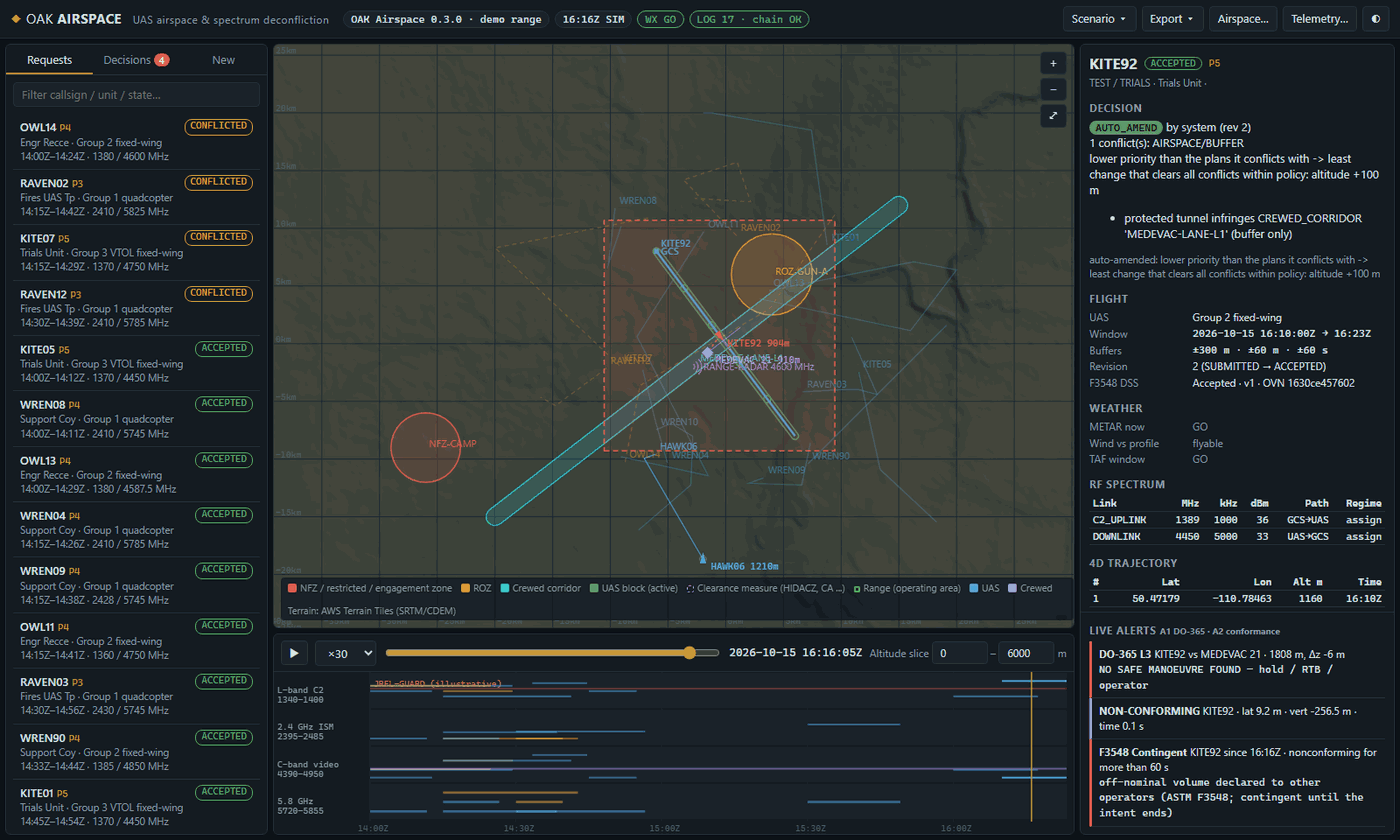
OAK Airspace plans, deconflicts and controls uncrewed aircraft traffic on a shared range or operating area. Every flight plan carries its 4D route and its radio links, so a request is checked against other aircraft, airspace control measures, crewed traffic, the weather and the spectrum in one pass. The rules settle what policy allows them to settle. Everything else goes to a human decision queue with the options laid out, and every decision is written to a tamper-evident log.

Each request is checked in 4D against every other plan, every control measure, crewed traffic, terrain, the forecast and every radio link already approved. The same inputs always give the same verdict.
No conflict. The plan is approved and its airspace blocks are published.
A lower-priority request gets the least change that clears every conflict within policy: a delay, a new altitude, or a re-tuned link.
Equal priority, bumping an accepted plan, or weather outside the aircraft's limits. The deciding authority sees the options and chooses.
A route through an active live-fire area, for example. The planner offers a new route around it.

Command uplink, downlink and payload links, each with frequency, bandwidth, power and receiver sensitivity, checked for in-channel interference in 4D alongside the airspace.
Frequency-hopping sets and mesh networks are judged by their share of time on a channel, with planned alternates, so a conflict can be resolved by a notch, an alternate or a re-tune.
Guard channels and fixed emitters such as a range radar are part of the environment, not an afterthought.
An operator can report interference they actually observe. It is weighed against the plan and can trigger a re-check, and the console suggests free channels.
Each link is flagged as licence-exempt under ISED RSS-247 or as needing a frequency assignment. Advisory, shown in the RF table.
15 doctrinal coordinating measures (JP 3-52), ACO-style import, and ICAO-format NOTAMs. Clearance measures go to the human queue naming the controlling authority.

Reads their telemetry (MAVLink, STANAG 4586, Cursor-on-Target) and can upload approved missions over MAVLink. It does not fly the aircraft.
Exports tunnels and blocks as GeoJSON, an ACO-style listing and Cursor-on-Target. It also runs as a view in OAK Mission Console.
A single Windows application, about 20 MB, using the Python standard library only. No cloud, no GPU, and nothing to install on the aircraft.
Bring a day's flight requests, your control measures and your frequency list. We load them, show you what the rules settle on their own, and what they put in front of a person.
Request a demo