The console
Draft → compose → send → inbox → picture → export → audit
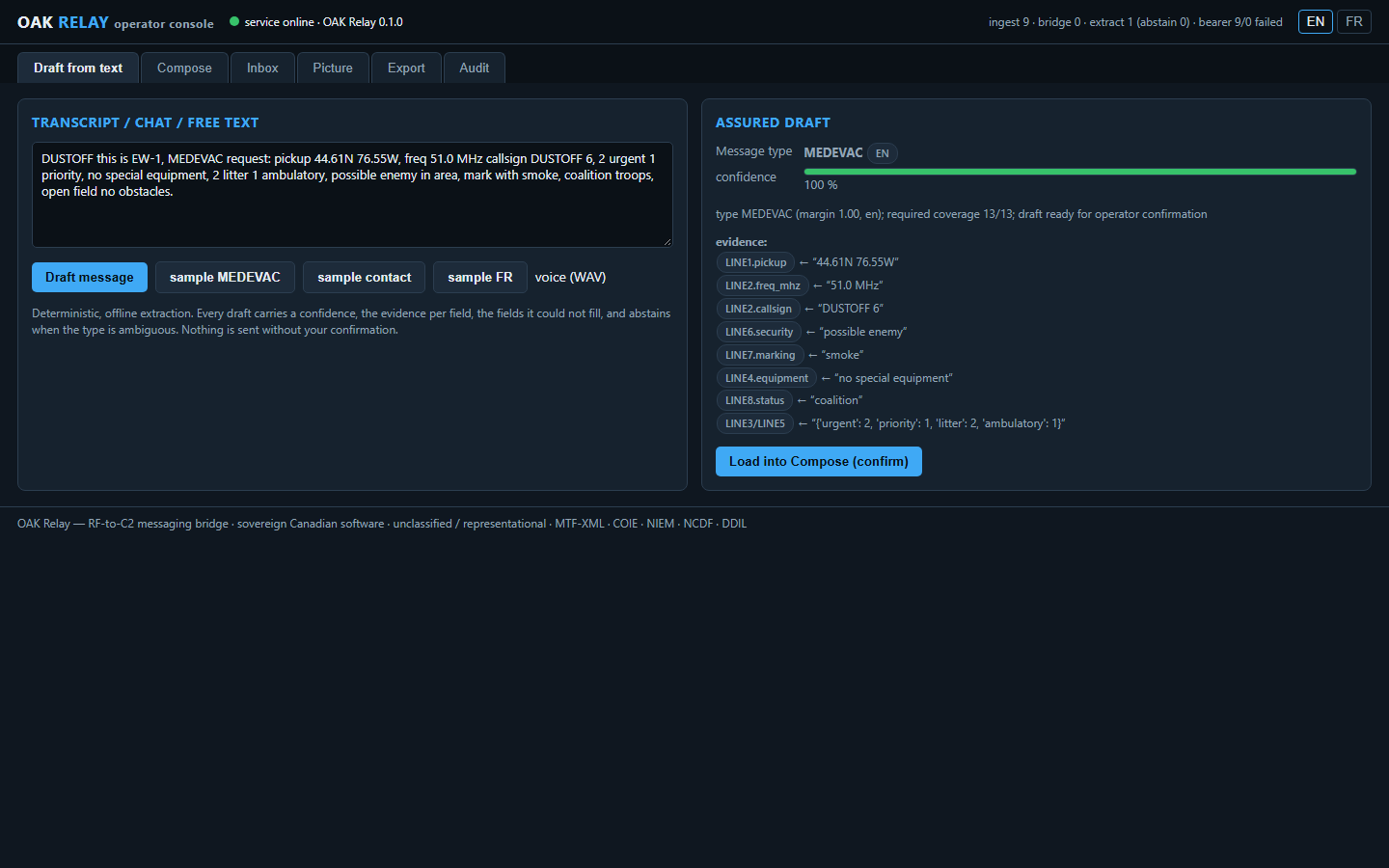
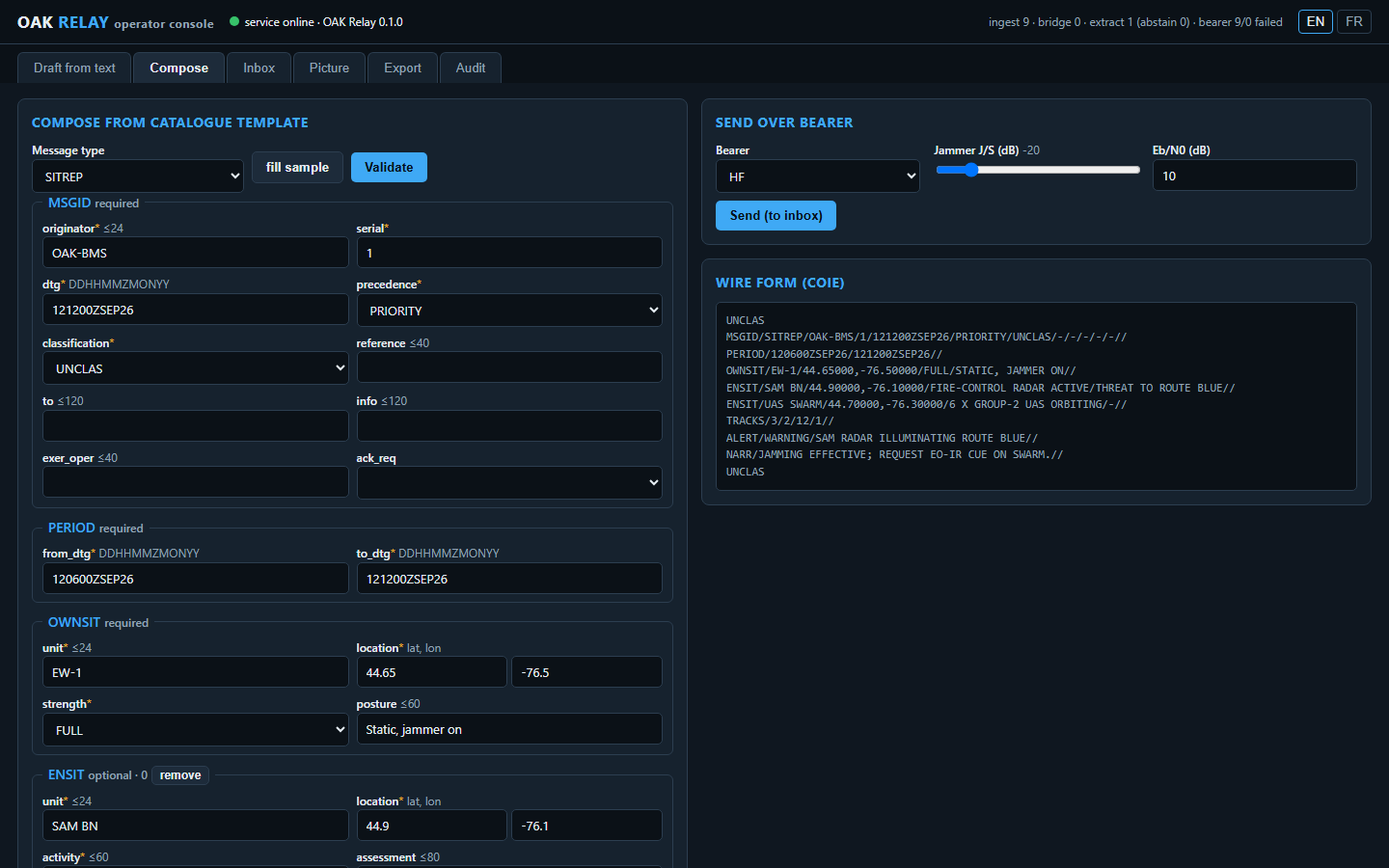
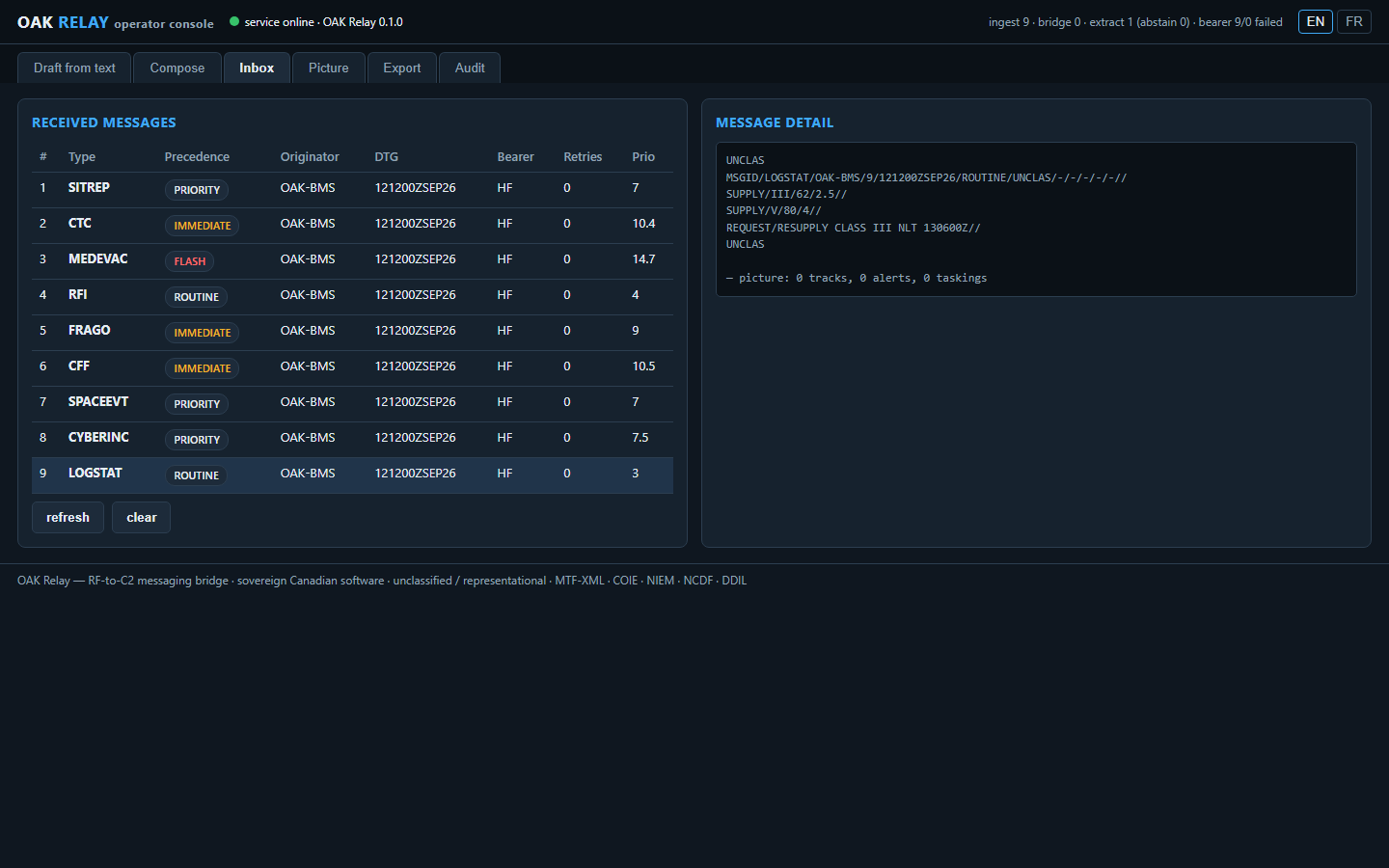
A bilingual (EN/FR) operator console served by the same process. Screenshots are captured by the build from the live service.
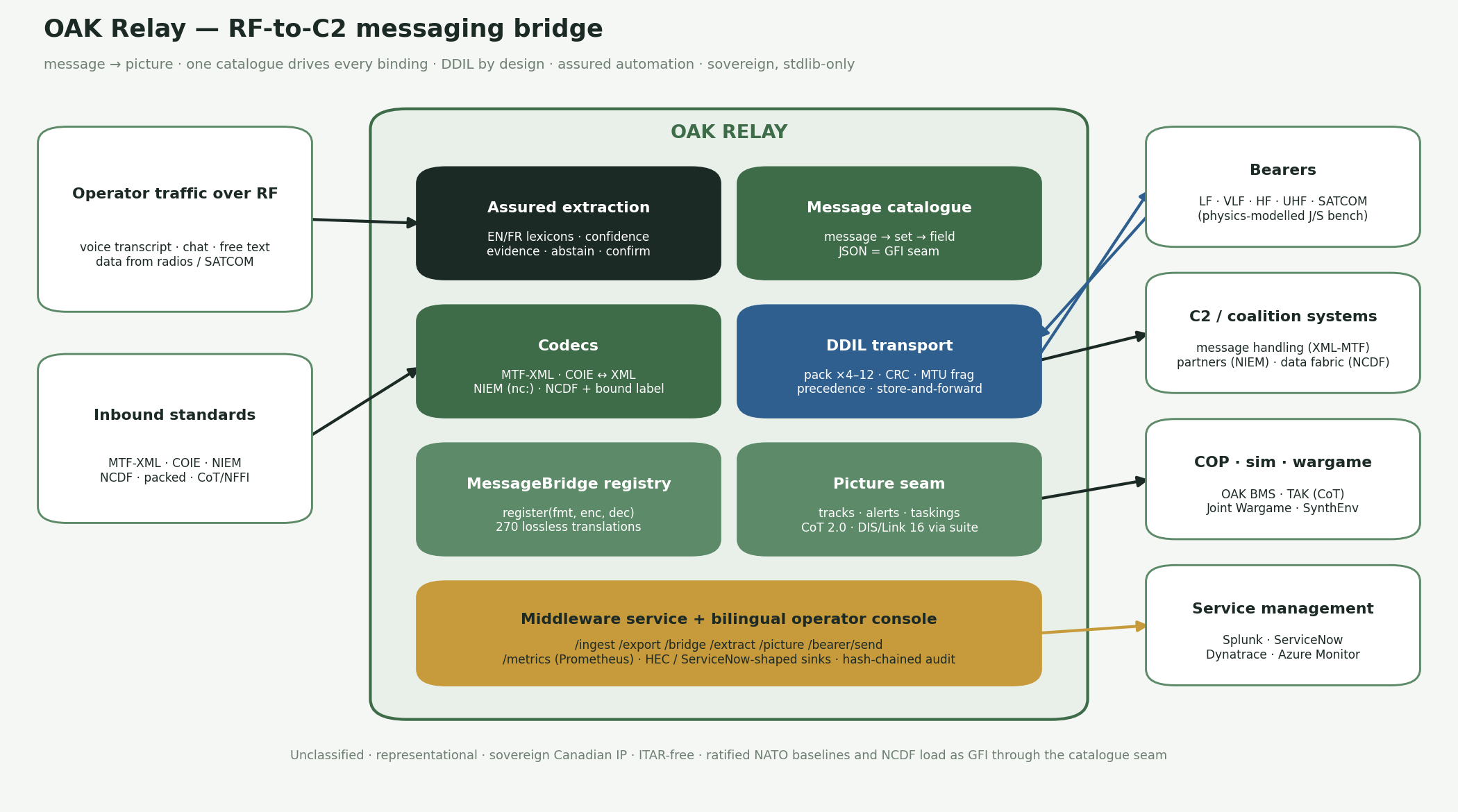
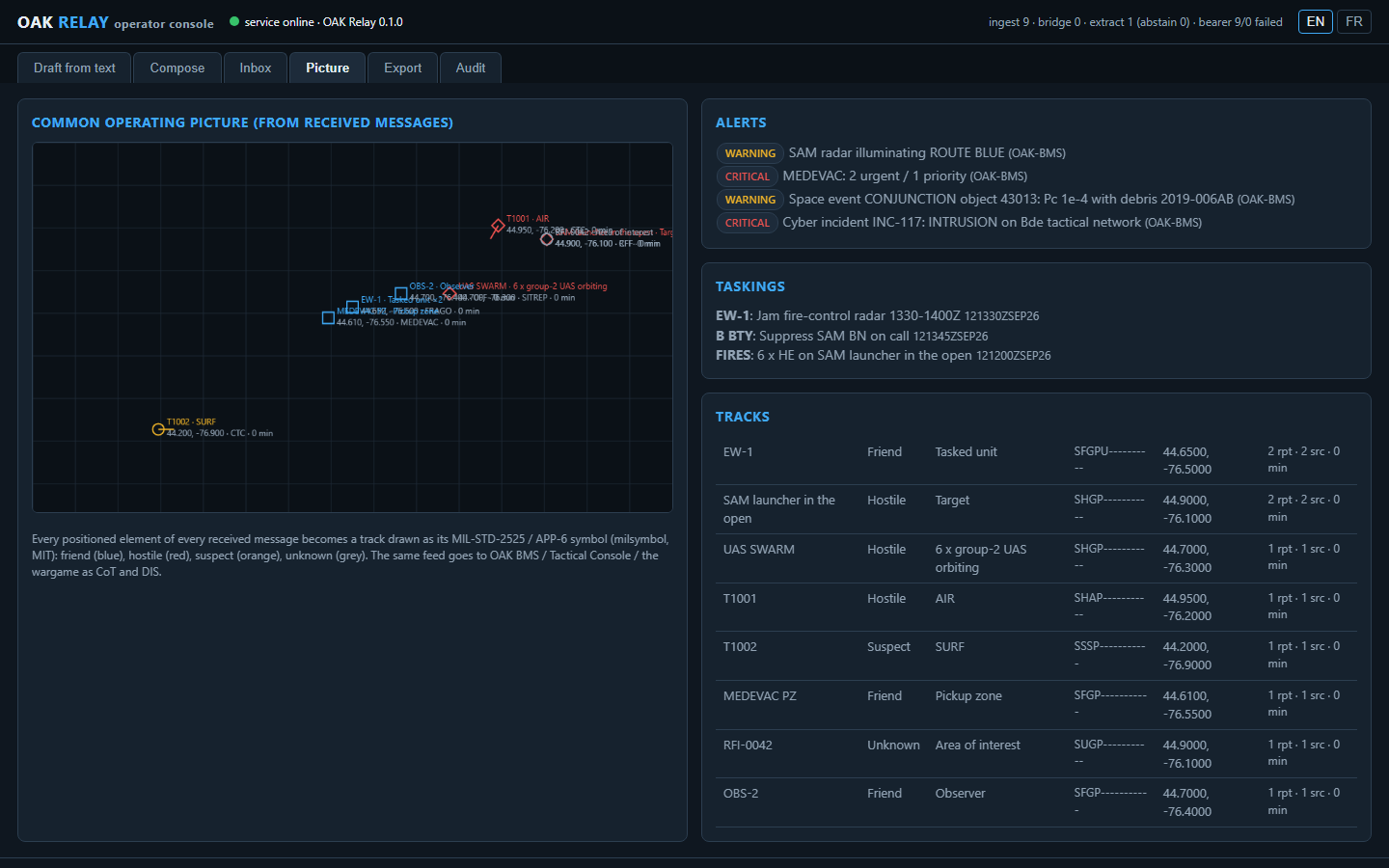
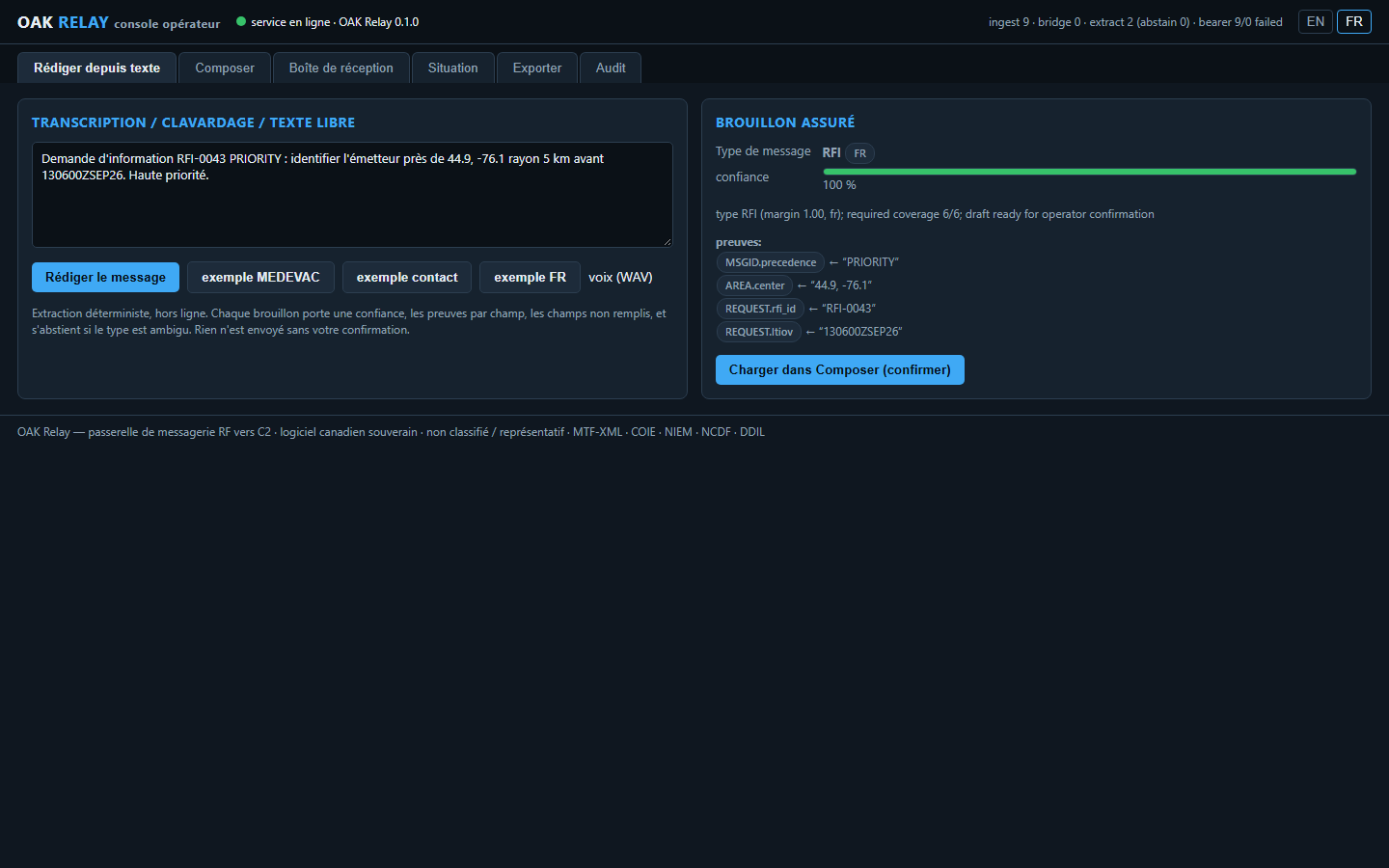
OAK Relay turns what operators produce over RF bearers — voice, chat, free text and data — into standards-compliant, machine-readable C2 messages (MTF-XML, COIE text, NIEM 6.0, an NCDF-style core-data object with a bound confidentiality label), packs them for LF/VLF/HF/UHF/SATCOM bearers, gets them through denied, degraded, intermittent and low-bandwidth links with precedence and store-and-forward, and fuses what arrives into one picture. Every claim below links to a generated, hash-stamped artefact.
A machine-readable catalogue (message → sets → fields, occurrence rules, FFIRN/FUD identifiers, addressing) drives every codec, so a new standard — or a ratified baseline supplied as Government-Furnished Information — is a data file. The bearer is a measured design variable, not an assumption.
MTF-XML (XML-MTF structural pattern), COIE character-oriented text with lossless transcoding, NIEM 6.0 validated against the OASIS schemas and the NIEMOpen CMF tool, an NCDF-style core-data object with an ADatP-4774.1-shaped label bound by SHA-256, Cursor-on-Target (MITRE schema-valid, TAK protobuf), DIS 7, STIX 2.1.
Typed binary packing, CRC-16, MTU fragmentation, FLASH→ROUTINE precedence, store-and-forward with selective repeat, a physics bench (BER vs Eb/N0 and jammer J/S), a STANAG 5066 service model and SIS wire client, and a real UDP link between two stations with delivery receipts.
Voice (offline speech-to-text), chat lines and free text (EN/FR) become drafts with confidence, per-field evidence, missing fields, abstention and mandatory human confirmation — a synthesized radio call yields a complete MEDEVAC 9-line.
Every received report is correlated into one persistent picture — by identifier, then name, then a position gate — latest wins with history, report counts, sources and staleness; rendered as MIL-STD-2525 / APP-6 symbols for TAK-class tools, OAK BMS and the OAK wargame.
Stdlib HTTP middleware with Prometheus metrics, Splunk HEC and ServiceNow push clients (tickets opened on CRITICAL alerts, store-and-forward on refusal), OpenAPI 3.0, API-key / TLS, SQLite persistence, tamper-evident hash-chained audit.
Score = (precedence + content) × staleness — casualties, hostile contacts, incident severity, time-critical windows — every factor listed in words; ranked inbox and a live-scored queue. Deterministic; any learned model plugs in behind the same contract.
Each artefact is produced by the build from the code under test. Sizes and SHA-256 digests are recorded in manifest.json (generated 2026-09-24).
| Artefact | What it shows | Size | SHA-256 |
|---|---|---|---|
| Requirement-traced V&V report | 97/97 checks, each tagged with the Essential or Desired Outcome it evidences, measured vs expected | 18,531 B | ed3171acf041a7b3… |
| Compliance traceability matrix | every Essential / Desired Outcome → implemented feature → module and function | 9,058 B | 896026ba09c8740b… |
| Interface Control Document | interfaces at a glance, endpoint table, catalogue schema summary, wire examples for every binding, NIEM IEPD manifest, bearer profiles | 57,337 B | 20548304b5136918… |
| OpenAPI 3.0 description | 49 documented endpoints, generated from the same table as the ICD; served live at /openapi.json | 36,422 B | 9af63abf645d7149… |
| End-to-end vignette | transcript → message → every standard → HF bearer under jamming → picture — with the measured numbers | 11,266 B | b3cfd1454ecef8bb… |
| NIEM 6.0 conformance report | NIEMOpen Common Model Format tool (x2m / mval / xval) over the extension schema and sample instances | 2,570 B | 9bba3677f09f09d1… |
| V&V run log | every execution of the pack: host, runner, commit, clean-venv, checks, tests, signature — rows from other hosts are the independent evidence | 2,467 B | c925db8cec8770e6… |
| Voice corpus evaluation | speech-to-text → drafting on real and synthetic voices: word error rate, type accuracy, coverage, abstention per language / speaker / condition | 14,994 B | 2aa1ab5410a6273e… |
A bilingual (EN/FR) operator console served by the same process. Screenshots are captured by the build from the live service.
MTF-XML and COIE implement the structural model and bindings; ratified APP-11 / ADatP-3 / MIL-STD-6040 baselines and the NATO Core Data Framework are controlled-distribution and are not reproduced — they load through the catalogue seam as GFI. NIEM 6.0 is public (OASIS NIEMOpen) and implemented for real. Bearers are physics-modelled and exercised over real sockets; live radios and a real STANAG 5066 node are bench work. The STANAG 5066 wire framing is implemented from the standard's primitive definitions and is a conformance target, not a certified implementation. No standard is redistributed here.
Four minutes, no government data, any laptop.
Request a demo